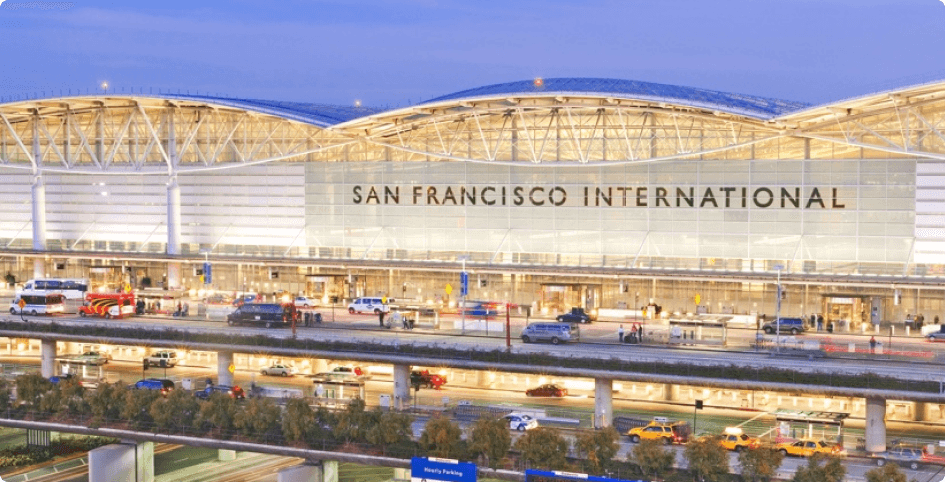
San Francisco International Airport (SFO) Guide | Terminals, Flights & Transport
 Monday, Jul 13, 2026
The San Francisco International Airport (SFO) is the gateway to the Bay Area and one of the key transpacific gateways in the US. SFO is the biggest airport in the Bay Area and the second busiest airport in California after the Los Angeles International Airport (LAX). In 2025, San Francisco International Airport handled approximately 57 million passengers, making it one of the busiest airports in the United States and among the world's busiest international airports. With its non-stop flights to more than 140 cities around the globe, SFO is San Francisco's principal airport, which offers international flights to Europe and Asia and is situated not far from the city's major sightseeing spots and business districts. Frankly speaking, there is no other airport like this one in the region.
What is San Francisco International Airport?
SFO, or San Francisco International Airport, is the main commercial airline airport in the San Francisco Bay Area. The airport is situated just 13 miles away from downtown San Francisco in an unincorporated part of San Mateo County.
Key Identifiers
Historical Background of SFO
A brief history of aviation services in San Francisco goes back into time for nearly a hundred years. San Francisco's city and county made a lease contract on March 15, 1927, for 150 acres of land at the present airport location and began constructing an experimental and temporary airport, which was dedicated on May 7, 1927, as the Mills Field Municipal Airport of San Francisco, located on the cow pasture of 150 acres of land.
The airport developed over the decades and became larger each year. Terminal 2 was constructed in 1954 and served as the main airport terminal. After being drastically rebuilt by Gensler, it took over from Rotunda A as the international terminal of SFO in 1983 until it was renovated because the current international terminal opened in 2000. A milestone in enhancing airport connectivity happened at the beginning of the new century. On February 24, 2003, the AirTrain people mover started functioning to deliver passengers to all terminals, parking areas, the BART station, and the rental car facility, and on June 22, 2003, the BART connection to the airport was finally established, allowing passengers to use BART trains.
Guide to Terminals and Concourses
As opposed to Denver, where there is one terminal only, San Francisco Airport (SFO) consists of four terminals: 1, 2, 3, and International, each of which is linked via airside connectors that enable changing terminals without passing through security again. The terminals are organized around seven boarding areas (concourses): A to G.
Harvey Milk Terminal 1 - Originally referred to as the South Terminal, Harvey Milk Terminal 1 includes Boarding Area B, consisting at the moment of 26 gates (B2-B27), and Boarding Area C with 11 gates (C1-C11). Terminal 2 - One of the airport's oldest terminals at San Francisco International Airport boasts a long and distinguished green legacy; being the first US airport terminal to obtain LEED Gold certification, it is one of the oldest terminals at San Francisco International Airport. Terminal 3 - Being the former North Terminal, Terminal 3 is the hub for United Airlines passengers and consists of 36 gates in two concourses, E and F. This environmentally friendly airport terminal has a solar roof and is going through a complete renovation to increase check-in capacity, add a centralized security screening facility, upgrade dining and retail areas, etc. International Terminal - Serving all international flights (and some domestic ones), this terminal is split into Boarding Areas A and G, which have gates A1-A15 and G1-G14 respectively. One can also find here such sights as the Aviation Museum Library and the SFO Museum, which was the first museum to be located in an international airport. AirTrain is a completely automatic system of people movers at SFO. AirTrain works before the security checkpoint and provides access between all terminals, car rental places, and long-term parking areas, consisting of two tracks operating in opposite directions, which operate continuously every four minutes during the whole day. Red Line provides access to all terminals, their parking lots, and the BART rail station, whereas Blue Line operates between car rental places and terminals of the airport, including the BART rail station. However, there is no need to use the train as there are airside connectors in SFO, allowing passengers to transfer between adjacent terminal buildings remaining in the secure zone – starting from June 17, 2024, there are airside connectors between A gates of International Terminal to Terminal 1, Terminal 1 to Terminal 2, Terminal 2 to Terminal 3, and Terminal 3 to the G gates of the International Terminal. SFO has one of the most extensive lobby offerings in the US. The majority of SFO’s nearly 20 lounges are managed by foreign airlines like China Airlines, Emirates, and Cathay Pacific, as SFO serves as an important hub airport for flights to Asia and Europe. Despite sitting on the bay 13 miles south of the city, SFO is superbly connected at every price point. BART (Airport Rail): The most affordable and convenient option. Bay Area Rapid Transit (BART) serves San Francisco International Airport with direct connectivity to downtown San Francisco, providing travelers with an easy option to reach the city. Passengers access the BART station from level 3 of the International Terminal main hall. SamTrans Buses: SamTrans routes 140, 292 and 397 run 24/7 between SFO, Daly City and Palo Alto, with fares from $2.25. Rideshare (Uber / Lyft): Uber, Lyft and Wingz pick up domestic passengers on Parking Garage Level 5, while international rides depart from Departures Level islands 14–17. Taxis: Metered taxis queue outside baggage claim, averaging $55–$70 to downtown. Car Rentals: The Rental Car Center (accessible via the AirTrain Blue Line) hosts Alamo, Avis, Budget, Dollar, Enterprise, Hertz, National, Sixt and Thrifty. For those driving, SFO is readily accessible via US-101 and I-280, with ample parking available. The combination of geographic advantage, leadership in sustainable development, and top-tier facilities makes San Francisco unique compared to other aviation gateways. Transpacific Gateway for America: SFO is a hub for United Airlines and serves as its main gateway to Asia and one of its main maintenance bases. Taipei, Taiwan, was the number one international destination at SFO in 2024, with 1.36 million passengers. Leader in Sustainable Aviation: The five-year strategy of SFO is to become the first airport in the world to have zero carbon, zero waste, and zero net energy. Expanding Network: July was the busiest month in 2025, with 5.28 million passengers, while passenger traffic continues to increase following 54.53 million passengers handled in 2024. Starting December 11, flights to New Chitose Airport (which serves the greater Sapporo region) from SFO will be offered three times per week using a Boeing 787- 9 (the only non-stop flight linking Sapporo to North America). Recent expansion has also seen the restoration of flights between San Francisco and Barcelona, as well as new routes between San Francisco and San Jose, Costa Rica. SFO is far more than another airport on America's west coast – it is one of the key foundations of America's aviation. It is the critical Pacific passage for United Airlines' international network and the key gateway to Silicon Valley, the wineries, and the entire Northern California area. Knowing how the terminals at SFO are arranged, what lounges there are, and how the transport system works will certainly make your trip easier and more comfortable regardless of whether you are traveling across the Pacific Ocean or within the country. Ques 1: What is the airport code of San Francisco International Airport? Ans: The IATA code of San Francisco International Airport is SFO and its ICAO code is KSFO. Ques 2: How far is SFO from downtown San Francisco? Ans: The airport is 13 miles south of Downtown San Francisco. There is a direct railway route from the airport to San Francisco city via BART. Ques 3: What airlines are the hubs at SFO? Ans: San Francisco International Airport is a United Airlines hub, where the airline serves as its main gateway for transpacific flights and also as an Alaska Airlines hub. Ques 4: Is there a free train in SFO? Ans: Yes, the easiest way to travel within the airport is the AirTrain. It operates 24 hours a day, has frequent service, is free, and has various stops including all terminals, the rental car facility, and the BART station. Ques 5: Can I travel from SFO to downtown San Francisco using the train? Ans: Yes, that is possible. You may board BART trains at SFO and have a direct rail link to downtown San Francisco, Oakland, and the East Bay. Ques 6: How busy is SFO? Ans: SFO was the 13th busiest airport in the United States and the 32nd busiest airport in the world in 2025 in terms of passenger movement, and in 2024, SFO registered 54.53 million passengers.Connecting Between the Terminals
San Francisco International Airport (SFO) Lounges
Terminal 1
Terminal 2 & Terminal 3
International Terminal
Getting to and From SFO
What makes SFO unique?
Conclusion
Frequently Asked Questions
Recent Articles

 Wednesday, May 13, 2026
Codeshare Flights Guide: How They Work and What Travelers Should Know

Thursday, May 14, 2026
The Real Secret of Airlines- Tips & Tricks to Getting Upgraded to Business Class

Monday, Jun 01, 2026
AI vs Manual Flight Booking: Which Saves More Money in 2026?

Thursday, Jun 04, 2026
Miami International Airport Guide | All That You Need to Know Before Booking

Tuesday, Jun 16, 2026
Miami Executive Airport (TMB): Everything About Runway, Facilities, and History

Tuesday, Jun 16, 2026
Miami-Opa Locka Executive Airport (OPF): Runway, History, And Other Key Information

Friday, Jun 19, 2026
Chicago Midway Airport (MDW): Everything You need to know before your trip

Friday, Jun 19, 2026
Chicago O'Hare International Airport (ORD) Guide | Terminals, Lounges & Transportation Information

Tuesday, Jun 23, 2026
Harry Reid International Airport (LAS) Guide: Terminals, Lounges, Parking & Transportation

Tuesday, Jun 23, 2026
Denver International Airport (DEN) Guide: Lounges, Parking, Security & Airlines

Friday, Jul 10, 2026
LaGuardia Airport (LGA): Terminals, Airlines, Transport & Travel Guide

Friday, Jul 10, 2026
John F. Kennedy International Airport (JFK) Guide: Terminals, Lounges & Transportation

Tuesday, Jul 14, 2026
Newark Liberty International Airport Guide | EWR Airport Complete Information

Wednesday, Aug 05, 2026
Harry Reid International Airport (LAS) Guide | Terminals, Lounges & Transportation

Friday, Sep 11, 2026
Los Angeles International Airport (LAX): The Things To Consider Before Reaching The Airport
Grab the Best Deals for a Smart Way to Save for Your Upcoming Trip!
