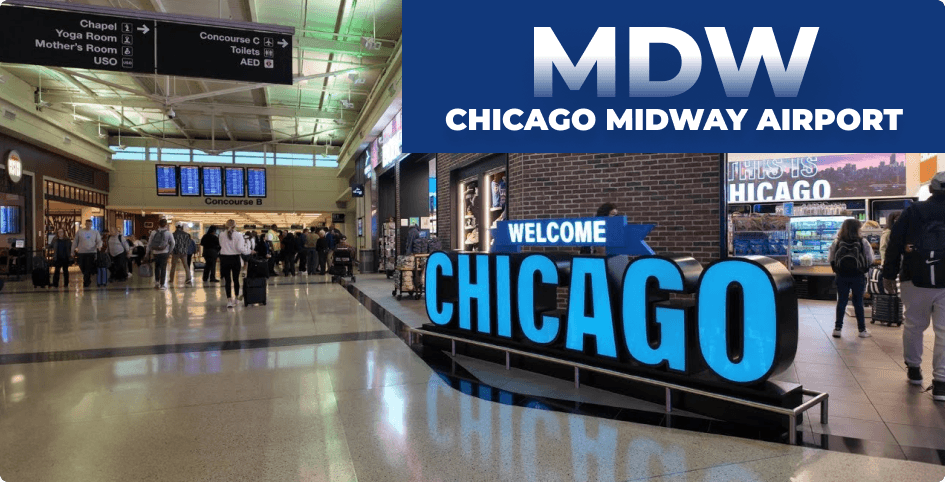
Chicago Midway Airport (MDW): Everything You need to know before your trip
 Friday, Jun 19, 2026
One of the most historic in American aviation and one of the most convenient, Chicago Midway International Airport (MDW) is just eight miles from downtown Chicago, just south of the city's core. Midway carries over 22 million passengers a year with flights connecting people to dozens of domestic and international cities. The compact and easy-to-navigate Midway Airport is Chicago's go-to airport for proximity and is Southwest Airlines' largest hub in the country. While most people will default to Chicago O'Hare International Airport (ORD) when flying into or out of Chicago, Midway is a simpler alternative.
What is Chicago Midway International Airport?
The Chicago Midway International Airport (also referred to as Midway Airport or MDW) is the primary commercial airport operated by the City of Chicago's Department of Aviation. Midway Airport is located in the Chicago neighborhoods of Clearing and Garfield Ridge and is situated just eight miles southwest of downtown Chicago, making it one of Chicago's most convenient airports.
It's the second-largest airport in the city and the second-largest in Illinois. Southwest Airlines calls Midway International Airport its largest hub, having more departures from MDW than any other airport in its entire network. However, there are several other airlines that fly into and out of Chicago Midway, including Volaris, Frontier, and Delta. MDW is comprised of one terminal split between three concourses, which many passengers consider to be among the easiest to navigate major airports in the United States.
Key Identifiers
History of MDW
Chicago Midway International Airport has experienced an incredible tale of the highs, the lows, and a resurgence of epic proportions.
The land where Midway now stands was utilized as an airfield as early as 1923, then informally known as Chicago Air Park. In 1926, the city of Chicago leased the field for a commercial venture, and on December 12, 1927, it was officially dedicated as Chicago Municipal Airport, with the airport already providing airmail, express, and passenger service. It was this same year that the first airmail plane landed here from Omaha, Nebraska, piloted by Captain Ira O. Biffle, who taught Charles Lindbergh everything about flying, and the airport was just 6 months behind Lindbergh's transatlantic flight, catching all of the frenzy and enthusiasm that came with the air age.
Growth was phenomenal and instantaneous; 1928 saw the field boast 12 hangars and 4 runways lightened for nighttime flight, carrying nearly 40,000 passengers along 15,000 flights. By 1931, a functional terminal and administration building had been erected at 62nd Street, passenger numbers reached over 100,000, and that year, Chicago Municipal Airport declared itself to be the world's busiest airport - it was correct. Throughout the 1930s and 1940s, the airport developed further into America's commercial aviation hub; airlines such as United, American, and TWA operated heavily from the field.
Terminals and Concourses
Midway International Airport in Chicago only has one passenger terminal and it is made up of three concourses: A, B, and C. All three concourses are linked post-security by the Central Market space, so it is not required for passengers to take a train or clear security again in order to move from gate to gate.
Arrivals are on Level 1 (Lower Level), and check-in, ticketing, and departures take place on Level 2 (Upper Level). Midway's structure is designed so that it is easy, and the walking distance between two points in the terminal is less than ten minutes.
Note: Southwest dominates Concourses A and B of MDW, which provides it with 229 daily departures out of MDW, which is more departures than any other single U.S. Airport that Southwest serves. Concourse B is the biggest concourse of the two, offering more facilities and services (especially the broadest dining and retail options). All private charter departures out of MDW only utilize Concourse C, which provides three charter aircraft gates.
MDW airport lounges
MDW did not have an airport lounge during most of its nearly 100-year history, but this changed in 2024. Today, MDW has two airport lounges that you can access.
The Club MDW (Central Market - concourses A & B)
USO Lounge (Concourse C)
Ways to and from MDW
Midway is considered one of the most accessible airports in the United States, and that's all due to its direct link to downtown Chicago via the CTA Orange Line.
CTA Orange Line (Rapid Transit): The fastest and most common route from Midway into downtown Chicago. Travel to the Loop will take approximately 30 minutes. The Orange Line station is physically attached to the terminal itself, and it is a no-transfer commute.
Pace Bus: Pace runs its own regional bus system from Midway to many surrounding Chicago suburbs, including those within Cook and DuPage counties.
CTA Bus: Many routes for the Chicago Transit Authority system stop at Midway station for direct connection to neighborhoods all over Chicago and other transit hubs.
Metra (River Valley Metro at Midway): Connect at Midway station with select Metra routes servicing communities south and southwest of the city.
Rideshare & Taxis: Traditional taxis, as well as Uber and Lyft, are available at the Ground Transportation area on the arrivals level (level 1). Pickup zones for rideshares are clearly marked.
Car Rentals: Major rental car companies all have services at Midway and can be accessed by shuttle bus. This complimentary shuttle runs every 15 minutes available 24/7.
Parking at MDW
MDW has various parking levels that correspond to trip length and price, in addition to the covered 1999 structure (updated in the Midway Modernization Program), which is directly connected to the MDW terminal.
How it works: You can pre-book your parking space through the main MDW or CDA website. The main garage includes electric car charging points that were implemented as part of the 2023 modernization. Hourly rates and daily rates will fluctuate according to the season and demand - the airport website is recommended to check before traveling. Economy lots provide significant savings when parking for a trip of 2-3 days or more. Midway International Airport occupies an important, irreplaceable position within American air travel history. It was once the unchallenged center of the world's air travel and, although it does not carry that designation any longer, it remains intrinsically linked to Chicago's aviation heritage. Important Historical Facts 1927: opened as Chicago Municipal Airport with its first airmail plane touching down from Omaha, Nebraska 1929: named the world's busiest airport 1932: declared the world's busiest airport 1948 - 1960: It was the busiest commercial airport in the world, even surpassing LaGuardia Airport in New York City. 1949: renamed Midway in recognition of the Battle of Midway during World War II 1993: Chicago Transit Authority (CTA) Orange Line opened, providing direct train service from the airport to downtown Chicago 2001: new terminal building opened, marking the end of the transformative Terminal Development Program 2023: completed the Midway Modernization Program, which includes a redesigned Central Market and expanded security checkpoints 2024: First-ever passenger lounge opens at MDW-The Club MDW, and more than 22 million passengers utilize MDW. More than just the second airport of the City of Chicago, Midway is one of the founding members of the American commercial airline industry, a neighborhood hub on the city's South Side, and truly a convenient gateway for millions of people each and every year. From a Southwest Airlines flight to a domestic destination to a layover connection to Mexico or the Caribbean to a more streamlined experience at an airport than that provided by a megalopolis hub, MDW works. Understanding the concourse layouts, lounge opportunities, transportation access, and parking options in advance of arrival will help ensure that your experience at Midway goes quickly and pleasantly.What is special about MDW?
Conclusion
Recent Articles

 Wednesday, May 13, 2026
Codeshare Flights Guide: How They Work and What Travelers Should Know

Thursday, May 14, 2026
The Real Secret of Airlines- Tips & Tricks to Getting Upgraded to Business Class

Monday, Jun 01, 2026
AI vs Manual Flight Booking: Which Saves More Money in 2026?

Thursday, Jun 04, 2026
Miami International Airport Guide | All That You Need to Know Before Booking

Tuesday, Jun 16, 2026
Miami Executive Airport (TMB): Everything About Runway, Facilities, and History

Tuesday, Jun 16, 2026
Miami-Opa Locka Executive Airport (OPF): Runway, History, And Other Key Information

Friday, Jun 19, 2026
Chicago O'Hare International Airport (ORD) Guide | Terminals, Lounges & Transportation Information

Tuesday, Jun 23, 2026
Harry Reid International Airport (LAS) Guide: Terminals, Lounges, Parking & Transportation

Tuesday, Jun 23, 2026
Denver International Airport (DEN) Guide: Lounges, Parking, Security & Airlines

Friday, Jul 10, 2026
LaGuardia Airport (LGA): Terminals, Airlines, Transport & Travel Guide

Friday, Jul 10, 2026
John F. Kennedy International Airport (JFK) Guide: Terminals, Lounges & Transportation

Monday, Jul 13, 2026
San Francisco International Airport (SFO) Guide | Terminals, Flights & Transport

Tuesday, Jul 14, 2026
Newark Liberty International Airport Guide | EWR Airport Complete Information

Wednesday, Aug 05, 2026
Harry Reid International Airport (LAS) Guide | Terminals, Lounges & Transportation

Friday, Sep 11, 2026
Los Angeles International Airport (LAX): The Things To Consider Before Reaching The Airport
Grab the Best Deals for a Smart Way to Save for Your Upcoming Trip!
