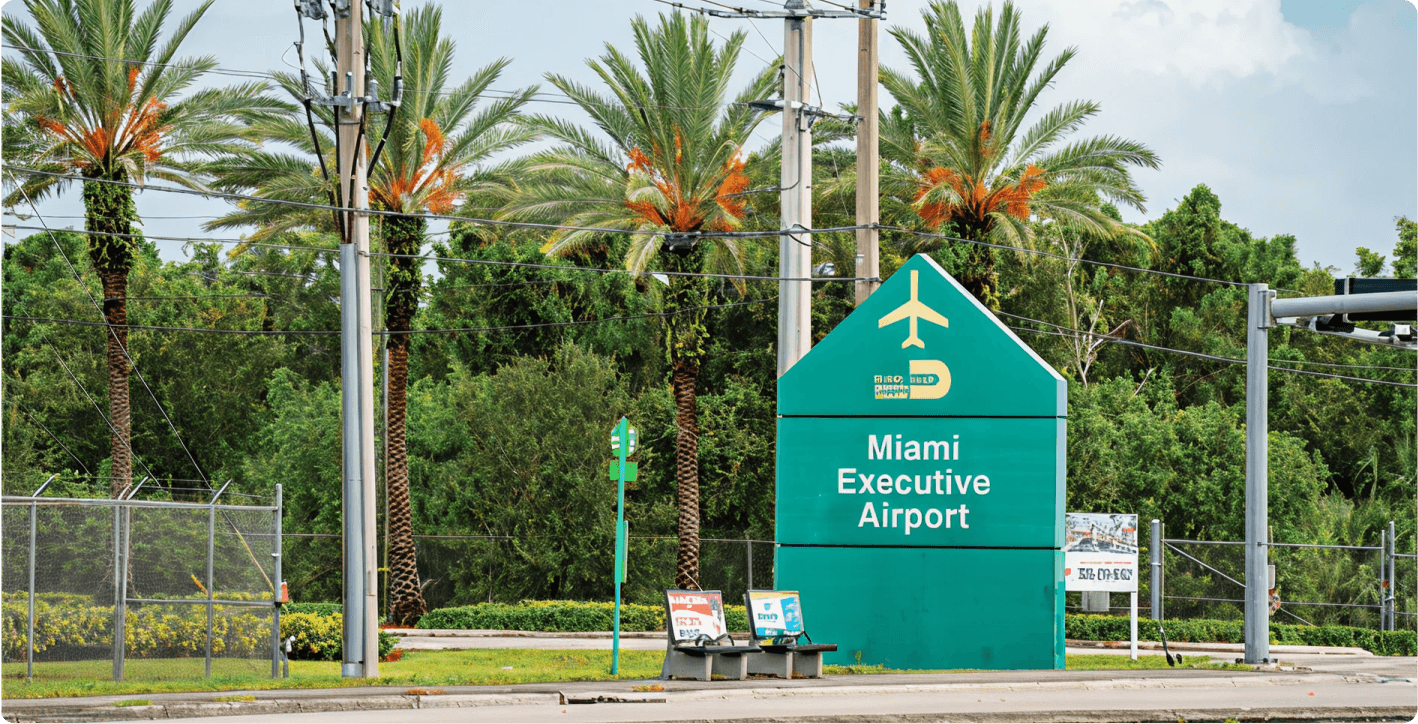
Miami Executive Airport (TMB): Everything About Runway, Facilities, and History
 Tuesday, Jun 16, 2026
Located 13 miles (21 km) south-southwest of Downtown Miami and classified as one of Florida’s most important general aviation airports, Miami Executive Airport (TMB IATA code) caters specifically to those traveling on private planes, business trips, and flight students in the Miami area. As a primary airport for Miami International Airport (MIA) and one of the other known airports, Miami-Opa Locka Executive Airport (OPF), TMB helps reduce traffic at one of the busiest international airports. With 272,797 aircraft operations carried out in 2023, the importance of the airport should not be underestimated, despite it being non-commercial. The main differences between TMB and MIA lie in TMB's specific features: speed, flexibility, and a personalized approach. If you plan on traveling via private jet, obtaining your pilot’s license, or even passing through en route to the Florida Keys, you will find nothing better than Miami Executive Airport. Miami Executive Airport was called Kendall-Tamiami Executive Airport until it was renamed to Miami Executive Airport in 2014. The airport operates as a general aviation airport that is publicly owned. It is run by the same body that runs Miami International Airport, namely, the Miami-Dade Aviation Department (MDAD). There are no commercial airline services at TMB. Instead, the airport is used as a center for corporate aviation, charters, recreational purposes, flight training, law enforcement aviation operations, and government air travel. The proximity of the airport to the Ronald Reagan Turnpike means that it acts as a gateway into South Miami-Dade County, Coral Gables, Coconut Grove, Pinecrest, and the Florida Keys. The history of Miami Executive Airport is inextricably linked with the development of the entire general aviation industry in South Florida. Initially created in order to support the growing number of private general aviation flights in Miami-Dade County, Miami Executive Airport has undergone decades of upgrades and modernizations. During the vast majority of its existence, Miami Executive Airport was called Kendall-Tamiami Executive Airport, referring both to the location of the airport, which was close to US-41 (known as Tamiami Trail) and to the city of Kendall situated in southwest Miami-Dade. Over the years, the airport developed into one of the busiest centers for private flights and training in the state. One of the many chapters in its past relates to the formation of Wings Air Museum, which later became known as Weeks Air Museum, based out of the airport site. During the 1992 destruction wrought by Hurricane Andrew on South Florida, not only was this facility badly damaged, but the planes in its collection were mostly destroyed, and it ended up moving to Polk County. However, in 2001, a small group of military and classic aircraft lovers, namely Walter Orth, Larry Ploucha, Vincent Tirado, and Tom Righetti, started the Wings Over Miami Air Museum there. TMB boasts three paved runways, suitable for different types of planes, ranging from small planes for training to mid-sized and large-sized private jets. Please find the following details: Note: Runway 9R/27L is equipped with an Instrument Landing System (ILS). This implies that most of the jet traffic takes place on this runway. Navigational assistance at the airport includes a Non-Directional Radio Beacon and GPS approaches. The FAA-controlled tower runs all days except during the night period, i.e., from 7:00 a.m. to 11:00 p.m. The rest of the time air traffic control is handled by the FSS. The Fixed-Base Operators (FBOs) serve as the bedrock upon which the entire experience of General Aviation at Miami Executive Airport rests. As opposed to airline terminals, private flyers have access to FBOs where they can refuel their aircraft, get hangared, processed through customs, use crew lounges, and receive concierge services. The following is a list of the various FBO facilities operating at TMB at present: Important Information: It is important to know that there is U.S. Customs and Immigration clearance available for international private aircraft arrivals at TMB, so that travelers do not have to go elsewhere to handle their entry formalities. An important aspect of the uniqueness of Miami Executive Airport is the aviation community. Below is information about the different parts of the aviation community within TMB. There are several FAA-approved Part 141 flight schools operating at TMB. The airport offers structured education and pilot training programs for obtaining private, instrument, commercial, and multi-engine ratings. As such, TMB can be considered a center where many students of different flying academies train and receive their pilot certificates. Several FAA Part 145 (also JAA certified) Maintenance Repair Stations provide MRO services for fixed-wing aircraft and helicopters, ensuring that the airport has a self-contained MRO center. Miami-Dade Police Department's aviation unit is the main air base located within TMB. Air Rescue, AeroMed helicopters, various news channels' aviation units, and the Civil Air Patrol (which provides Search & Rescue services for the US military in the USA and abroad), TAMiami Composite Squadron SER-FL-355 of the US Air Force Auxiliary also use TMB facilities. The aviation degree program at Miami-Dade College relies on TMB as its operational base, thus allowing the students to get airside exposure during their studies. The linkage between the college and the working general aviation airport emphasizes that TMB acts as a community-based airport rather than just a transit facility. TMB houses the Miami Automated International Flight Service Station, which is the busiest FSS station across the entire nation. The Miami AIFSS flight plan area in South Florida experiences air traffic flight planning activity in much greater volumes than anywhere else in the nation due to massive private and general aviation movements. Access to and from TMB is simple owing to its location along major roads in South Florida. Travelers can follow the guidelines provided below: Travelers find that TMB is strategically located along Southwest 137th Avenue, also called Palm Drive, and the Ronald Reagan Turnpike (Florida’s Turnpike). This gives easy access to the Florida Turnpike system, enabling quick and hassle-free travel to and from TMB, whether one wants to leave or arrive from such areas as Coral Gables, South Miami, Kendall, Homestead, or even from the Florida Keys. One usually needs 30 to 40 minutes when traveling from Downtown Miami to TMB. Both Uber and Lyft ride-share services operate in Miami Executive Airport and are available round-the-clock for the convenience of arriving travelers who wish to leave in a car. Passengers leaving the TMB terminal will also enjoy the benefit of a variety of car rental companies with counters at the airport. Miami Executive Airport offers sufficient parking facilities for all passengers and travelers. Short-term parking options are available near the terminal, whereas longer-term parking facilities can be utilized by those who are dropping off their cars during their stay. The airport provides designated ramp parking, T-hanger parking spaces (more than 160), and corporate hangars to aircraft owners/operators. Miami Executive Airport occupies an exclusive position in the hierarchy of the Miami-Dade region airports as well as within the South Florida travel network. This is why: Reliever Function: TMB Airport is officially designated as a reliever airport for Miami International Airport in the NPIAS (National Plan of Integrated Airport Systems), meaning it helps ease general aviation congestion at one of the busiest international airports in the world. Access To The Keys: TMB’s south-western location means it is the closest airport for people traveling to Ocean Reef, Key Largo and the Florida Keys archipelago. Fewer Flights, Faster Processing: In comparison to MIA, the number of flights landing and departing at TMB airport is much lower, which allows for shorter turnaround times, improved access to runways, as well as more efficient handling on the ground for private charters. U.S. Customs & Border Protection: Private international travelers can process their customs declaration procedures right at TMB airport without having to make a stopover at a commercial airport. NASA/SATS Program: TMB Airport took part in NASA’s Small Aircraft Transportation System (SATS) research program. Miami Executive Airport is much more than just the backup plan for those who feel that Miami International Airport is too much. This airport is a complete aviation ecosystem where you can find corporate jets, an aviation flight training school, law enforcement aviation units, an aviation museum, and among the best facilities in Florida’s aviation field, FBOs. Whatever your interest in aviation may be, whether it is flying on a private jet or just visiting a museum dedicated to aviation history, you will be able to find what you need at TMB. As one of the three Miami-Dade airports, along with Miami International Airport (MIA) and Miami-Opa Locka Executive Airport (OPF), it plays an integral role in the aviation industry of this area and quietly processes hundreds of thousands of aircraft operations annually. Is Miami Executive Airport a commercial airport? No. TMB does not offer any scheduled passenger airline services. It is a public-use general aviation airport that handles private jets, charter planes, corporate aviation, flight schools, and government operations. How close is Miami Executive Airport to Downtown Miami? TMB is located roughly 13 miles (21 km) southwest of Downtown Miami, and the drive will take 30-40 minutes. Which FBOs are at TMB? Among the FBOs operating at Miami Executive Airport are Signature Flight Support, International Flight Center (IFC), and Reliance Aviation, offering fueling services, hangars, crew facilities, and ground transportation. How many runways does Miami Executive Airport have? Miami Executive Airport has three asphalt runways: 9L/27R (5,001 feet), 9R/27L (5,002 feet — primary jet runway with an Instrument Landing System), and 13/31 (4,001 feet). What are the other airports located in the Miami area? In total, there are five airports owned by Miami-Dade County. However, the three major airports located in the Miami area include MIA, TMB, and OPF.What is Miami Executive Airport?
Important Information
History of Miami Executive Airport
Runways and Infrastructure Guide
FBO Facilities at TMB
Aviation Programs & Education & Community at TMB
Flight Schools: FAA Part 141 Flight Schools
Maintenance, Repair, and Overhaul Services
Police & Government Aviation
Aviation Program at Miami Dade College
Automated International Flight Service Station (AIFSS) at Miami
How to Get to and from Miami Executive Airport
By Car
Ride-Shares and Taxis
Car Rentals
TMB Parking Options
What Makes TMB Unique As An Airport?
Conclusion
Frequently Asked Questions
Recent Articles

 Wednesday, May 13, 2026
Codeshare Flights Guide: How They Work and What Travelers Should Know

Thursday, May 14, 2026
The Real Secret of Airlines- Tips & Tricks to Getting Upgraded to Business Class

Monday, Jun 01, 2026
AI vs Manual Flight Booking: Which Saves More Money in 2026?

Thursday, Jun 04, 2026
Miami International Airport Guide | All That You Need to Know Before Booking

Tuesday, Jun 16, 2026
Miami-Opa Locka Executive Airport (OPF): Runway, History, And Other Key Information

Friday, Jun 19, 2026
Chicago Midway Airport (MDW): Everything You need to know before your trip

Friday, Jun 19, 2026
Chicago O'Hare International Airport (ORD) Guide | Terminals, Lounges & Transportation Information

Tuesday, Jun 23, 2026
Harry Reid International Airport (LAS) Guide: Terminals, Lounges, Parking & Transportation

Tuesday, Jun 23, 2026
Denver International Airport (DEN) Guide: Lounges, Parking, Security & Airlines

Friday, Jul 10, 2026
LaGuardia Airport (LGA): Terminals, Airlines, Transport & Travel Guide

Friday, Jul 10, 2026
John F. Kennedy International Airport (JFK) Guide: Terminals, Lounges & Transportation

Monday, Jul 13, 2026
San Francisco International Airport (SFO) Guide | Terminals, Flights & Transport

Tuesday, Jul 14, 2026
Newark Liberty International Airport Guide | EWR Airport Complete Information

Wednesday, Aug 05, 2026
Harry Reid International Airport (LAS) Guide | Terminals, Lounges & Transportation

Friday, Sep 11, 2026
Los Angeles International Airport (LAX): The Things To Consider Before Reaching The Airport
Grab the Best Deals for a Smart Way to Save for Your Upcoming Trip!
