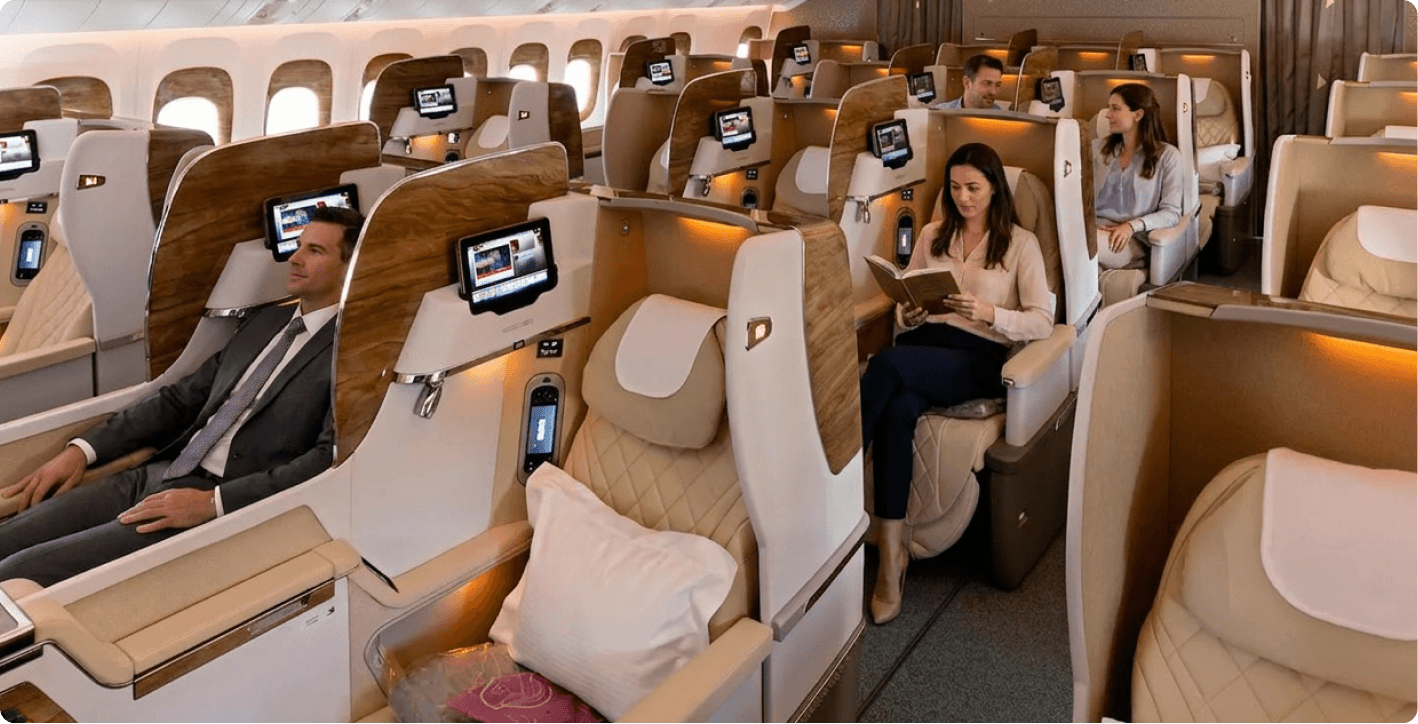
The Real Secret of Airlines- Tips & Tricks to Getting Upgraded to Business Class
 Thursday, May 14, 2026
Everyone has been there, as you shuffle down the aisle in economy, eyes wandering left to the wide leather seats, champagne flutes, lie flat beds — you think, What do those people know that I don't? The reality is that it's not usually a matter of luck. It's a strategy.
Laps don't just drop into business class. They provide their services to those travelers who know how airlines think, how points systems work, and how to be at the right place at the right time. From the very practical to the inside-the-box clever, this guide spells out all the legitimate ways to upgrade, and you'll no longer be waiting for an upgrade — you'll be creating one.
Why Airlines Upgrade Passengers?
You can't game the system if you don't know what it's for.
Every day, airlines operate with empty top-tier seats. Every day, airlines have empty first-class seats. The objective is to sell a business class ticket at full price — typically approximately $3,000 to $15,000 on international flights. However, it is worse to let it fly empty. Airlines have created a multi-layered approach to filling those seats, including loyalty programs, paid buy-ups, bidding auctions, and yes, sometimes, free upgrades.
The takeaway is: Airlines don't want to lose that revenue altogether; they want to do it on their own terms. Your task is to be the most desirable choice in their mind when they're making that choice.
Follow the tips and secrets below that airlines don't tell you
Build Elite Status: But Understand What It Gets You
There used to be free upgrades with elite status. That's a time that is rapidly passing — but it still matters.
In 2025, the three major U.S. carriers (American, Delta, and United) will all have undergone significant upgrades to their upgrade systems. In August 2025, American Airlines has increasingly shifted toward dynamic upgrade pricing instead of fixed upgrade charts. In November 2025, United discontinued fixed-price MileagePlus Upgrade Awards. Although Delta will still continue to offer free upgrades to Medallion elites on domestic flights, the airline has drastically cut the number of available upgrade seats as more seats are being sold at an increased price.

What does this imply for you? Free upgrades are becoming more exclusive to the top-tier elites (Delta Diamond, United 1K, American Executive Platinum) on certain routes and fare classes. The Powerful feeling of Gold and Platinum is now much more limited on most flights.
The “practical move” is to focus your spending on the top-tier when you fly one airline a lot. For moderate travelers, status is no longer the best option. Use with strategies below.
The Points and Miles Game
When it comes to the secret of the savvy traveler, there is one: transferable credit card points are the most reliable way to business class.
Here's how to do it. Rewards on cards such as the American Express Platinum Card, Chase Sapphire Reserve, and Capital One Venture X are flexible and can be redeemed for airline miles at a 1:1 ratio (or higher) with airline partners. Points earned in the airline's loyalty program can be used for business class award tickets at a reduced rate from that of a cash ticket.
What's hot right now in the U.S. market (2026):
Amex Platinum: 5X points on direct airline bookings, 1,550+ airport lounges. The annual charge has risen to $895 in September 2025, but the travel credits and transfer partners (Air France, British Airways, Singapore, ANA, and others) make it very powerful for premium cabin passengers.
Chase Sapphire Reserve: Revamped in 2025 with a $795 annual fee. Chase Travel bookings earn 8X, while direct bookings earn 4X. Transfers to United, Air Canada, Singapore, and more. One of the best travel cards around.
Capital One Venture X: A streamlined and budget-friendly plan for $395 per year and a nice $300 travel credit. Transfers to Air Canada Aeroplan, Turkish Airlines, and others.
Pro tip: Be on the lookout for transfer bonuses. Every so often, Amex and Chase will provide a 20–30% bonus mileage when you transfer to certain airline partners. These are time-limited windows during which a transfer of 50,000 points is equal to 60,000–65,000 miles, which can be a game-changer when you're booking premium cabins.
Upgrade Bidding
Economy passengers are allowed to submit bids for unsold premium seats in bidding programs. Airlines would prefer to have something rather than fly with an empty business class pod.
Over 50 airlines in the world currently have bid-to-upgrade programs. Among the most prominent are Lufthansa, Singapore Airlines, Aer Lingus, and Virgin Atlantic for those who travel internationally from the U.S. These programs usually provide you with an invitation to bid 7-14 days before you leave, and you can place a bid for a specific amount per person.
Note: U.S. flyers: The Big Three (American, Delta, and United) are NOT a part of a bid-to-upgrade program. They have a very high demand for their top-tier cabins on popular routes, so there's no need for an auction. The bidding is mainly for international airlines and a few small domestic U.S. airlines such as Hawaiian Airlines.
The smart way to bid:
Before bidding, research the full business class fare for your route.
As a starting point, bid 30-50% below the full retail price. You're not the only one who's bidding, but the airline wants to fill the seat, not get nothing.
If you bid on less popular routes or travel dates, your odds of success are greatly improved.
Bids are blind – meaning you do not know what others are bidding – but it is generally a losing proposition to underbid substantially. Be meaningful with your offer.
The Paid Upgrade Window: Buy-Up at the Right Moment
The price of airline upgrade buy-up offers varies dynamically. The more time that goes by from the time the flight is scheduled to leave, the more likely that the premium seats will become available at a lower price, or the further ahead, the lower the premium seats will look before demand increases.
The buy-up offer will be visible in the "My Trips" tab of the app for United, Delta, and American after they book a flight. The prices change every day, and there is no magic formula, but it pays to check repeatedly in the days before your flight, and it may well be that there is a period when the price drops to a reasonable level.
The best way to do this: establish a personal limit before you look. If you would pay $400 to make a 9-hour flight into a lie-flat flight, then check the daily, and when you see it at that number, you'll want to act. Don't be tempted by the excitement of seeing the cabin in person to rush into a buy-up at an inflated price.
Book the Right Fare Class in Economy
This is the one thing most travellers don't bother with and one of the most potent levers at their disposal.
Not all economy tickets are created equal. The letter after your booking (Y, B, M, H, Q, K, etc.) indicates your priority for upgrades. Full fare economy tickets (Y or B class) are almost always the first on the upgrade list. Third-party booking sites also offer deep-discount economy fares (N or G class) that are often not upgradeable at all.
In practice: If you want to get the best chance of upgrading, you should avoid the cheapest fare, or "basic economy" fares, and book directly with the airline. The cost of a basic economy ticket versus a standard economy ticket is far less than the benefit of an upgrade to business class, if available.
Check In Strategically: Timing is Everything
Upgrades are distributed around check-in time. Knowing about windows will change your approach to your travel day.
The upgrade clearance process for elites starts long before check-in even opens, even for top-tier elites, 100 hours before departure. The sweet spot, however, is different for non-elites who want to get paid or last-minute free upgrades:
Arrive at the airport as early as possible (usually 24 hours before the flight for most U.S. airlines). This is a great way to be one of the first to receive any upgrades that are offered at check-in.
When the flight is full in economy, the odds of getting a free upgrade increase. For operational reasons, airlines may need to move passengers up to free economy seats. First-come, first-served is important.
Gate agents make the final upgrade decisions within 30-60 minutes before boarding. You're in the room where it happens when you're here, polite, and visible, but not pushy.
Fly Routes With More Premium Inventory
Not all routes are created equal. There is more upgrade inventory on flights from New York to Los Angeles, New York to San Francisco, and some international flights that have larger business class cabins, which is 20-30% of the aircraft.
Alternatively, during the busy summer months, popular international flights are often fully booked in business class months ahead of time. There is no strategy to get you to a seat that doesn't exist.
The areas where upgrades are most likely to be effective:
Transatlantic flights on Tuesday or Wednesday (off-peak business travel)
Domestic long-haul routes (coast-to-coast)
If the flight has award/upgrade availability, it can sometimes be rerouted to another international flight with multiple daily flights.
Where there is the least capacity to upgrade:
Time of year when the vessel is most likely to be in use during the summer months on any transatlantic or transpacific route.
Days of the week (Fridays and Sundays)
Airport flights that are mainly business-oriented on Monday mornings and Thursday/Friday afternoons.
Putting It All Together: A Realistic Upgrade Game Plan
Let's see how a smart upgrade strategy is applied:
Begin with the right credit card and get transferable points on all purchases. Let the welcome bonus do the heavy lifting. Many cards will have enough points to book a round-trip business class ticket after they've been met.
If upgrade eligibility is an issue, book directly with the airlines in full-fare economy class. For any trip where you are looking to upgrade, steer clear of basic economy and third-party booking sites.
If flying an international carrier, inquire about a bid upgrade after booking and offer a competitive bid 7-14 days before travel.
If flying a U.S. carrier, check the buy-up price in your app every day for 2 weeks before travel. Have a budget and make a decision when it reaches your budget.
When travelling on the travel day, arrive as soon as possible. Dress well. Get to the gate in advance. Be politely present.
If none of the above is correct, you're in economy, you're still on your way to your destination. Be comfortable, be realistic, and begin to plan for the next trip.
Conclusion
The game has become tougher. Airlines have become wiser about revenue management, their premium classes have never been fuller, and free upgrades are rarer than ever unless you qualify as an elite passenger.
But the possibilities are still there - they've just changed. The days of bribing a gate agent into giving you an upgrade for free are behind us. The days of point maximization, timely bidding, and savvy fare classes are not gone by far.
The passengers seated in business class are not any luckier than you are. They made different plans. They strategically maximized their credit card purchases, and they knew the right window for upgrading.
This way of doing things is now within your reach.
Recent Articles

 Wednesday, May 13, 2026
Codeshare Flights Guide: How They Work and What Travelers Should Know

Monday, Jun 01, 2026
AI vs Manual Flight Booking: Which Saves More Money in 2026?

Thursday, Jun 04, 2026
Miami International Airport Guide | All That You Need to Know Before Booking

Tuesday, Jun 16, 2026
Miami Executive Airport (TMB): Everything About Runway, Facilities, and History

Tuesday, Jun 16, 2026
Miami-Opa Locka Executive Airport (OPF): Runway, History, And Other Key Information

Friday, Jun 19, 2026
Chicago Midway Airport (MDW): Everything You need to know before your trip

Friday, Jun 19, 2026
Chicago O'Hare International Airport (ORD) Guide | Terminals, Lounges & Transportation Information

Tuesday, Jun 23, 2026
Harry Reid International Airport (LAS) Guide: Terminals, Lounges, Parking & Transportation

Tuesday, Jun 23, 2026
Denver International Airport (DEN) Guide: Lounges, Parking, Security & Airlines

Friday, Jul 10, 2026
LaGuardia Airport (LGA): Terminals, Airlines, Transport & Travel Guide

Friday, Jul 10, 2026
John F. Kennedy International Airport (JFK) Guide: Terminals, Lounges & Transportation

Monday, Jul 13, 2026
San Francisco International Airport (SFO) Guide | Terminals, Flights & Transport

Tuesday, Jul 14, 2026
Newark Liberty International Airport Guide | EWR Airport Complete Information

Wednesday, Aug 05, 2026
Harry Reid International Airport (LAS) Guide | Terminals, Lounges & Transportation

Friday, Sep 11, 2026
Los Angeles International Airport (LAX): The Things To Consider Before Reaching The Airport
Grab the Best Deals for a Smart Way to Save for Your Upcoming Trip!
